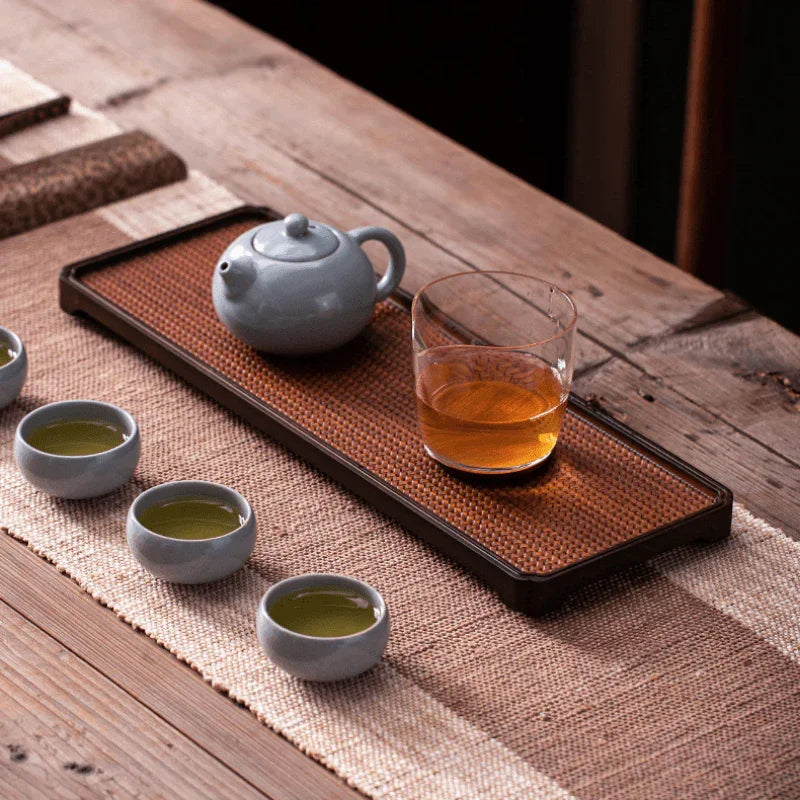
Walk into a well-stocked tea room and you may feel as though you are surveying hundreds of unrelated plants. Snowy-tipped buds sit beside emerald leaves, twisted dark pellets, and dense pressed cakes that look more like fossils than something you would steep in a cup. Yet here is the quiet wonder at the heart of tea: almost every one of them begins with the leaves of a single species, Camellia sinensis, an evergreen shrub native to the borderlands of southwestern China, northern Myanmar, and Assam. What separates a delicate white tea from a brooding aged pu-erh is not the plant. It is what human hands choose to do with the leaf after it is picked.
Chinese tea tradition organises this diversity into six great categories, usually distinguished by colour and, more meaningfully, by how the leaf is processed and how far it is allowed to oxidise. In this guide we will walk through all six in turn, from the barely-touched whites to the post-fermented dark teas, so that the next time you stand in front of that wall of tins, you will understand the family resemblance hiding within the variety.
One Plant, Six Faces: Why Processing Matters
Before we meet each type, it helps to understand the single most important word in tea: oxidation. When a tea leaf is plucked, it remains biochemically alive. Crush or bruise it, and enzymes inside the leaf begin reacting with oxygen, turning the green compounds brown and transforming flavour, aroma, and colour. This is the same browning you see when you slice an apple and leave it on the counter.
Tea makers control oxidation with extraordinary precision. To stop it, they apply heat early, a step the Chinese call shaqing, or “kill-green,” which deactivates the enzymes. To encourage it, they bruise and rest the leaves, letting the reaction build for minutes or hours. The six tea types are, in essence, six different answers to the question: how much oxidation do we want, and how do we get there?
A common point of confusion is worth clearing up now. Oxidation is not fermentation. Oxidation is an enzymatic reaction driven by the leaf’s own chemistry and oxygen. True fermentation involves microbes, bacteria and fungi, acting on the leaf. Only the last category, dark tea, relies on genuine microbial fermentation. The older habit of calling black tea “fermented” is a historical misnomer that lingers in casual speech.
With that foundation laid, let us begin where oxidation is gentlest.
White Tea: The Art of Restraint
White tea is the least processed of all six types, and in many ways the most honest expression of the leaf itself. The classic method involves only two steps: withering and drying. There is no pan-firing, no rolling, no deliberate bruising. The leaves and buds are simply allowed to wither, traditionally under indirect sun or in airy indoor rooms, and then dried. Because the leaves are handled so little, a small amount of oxidation occurs naturally during the long wither, so white tea is best described as lightly oxidised rather than entirely unoxidised.
The name “white” comes from the fine silvery-white down, called trichomes, that coats the unopened buds of certain cultivars. The most prized white teas come from Fujian Province, particularly the counties of Fuding and Zhenghe.
Flavour Profile
Good white tea is subtle and quietly complex. Expect notes of fresh hay, melon, cucumber, and a soft floral sweetness, often with a delicate honeyed finish. The texture can be surprisingly full and almost velvety. It is a tea that rewards attention; its pleasures are whispered, not shouted.
Notable Examples
- Bai Hao Yinzhen (Silver Needle): Made entirely from plump, downy buds, this is the pinnacle of white tea, prized for its elegance and gentle sweetness.
- Bai Mudan (White Peony): A blend of buds and the top one or two young leaves, fuller and more robust than Silver Needle, with greater body and a touch more depth.
- Shou Mei and Gong Mei: Made from more mature leaves, these are earthier and bolder, and they are popular candidates for ageing, mellowing beautifully over years.
Brewing Notes
White tea is forgiving but rewards slightly cooler water than you might expect, around 80 to 85 degrees Celsius, to protect its delicacy. Use a generous quantity of leaf and steep for two to five minutes, or longer for the leafier grades. Silver Needle in particular can be steeped many times, each infusion revealing a new layer.
Green Tea: Capturing the Living Leaf
If white tea is about restraint, green tea is about decisive intervention. The defining feature of green tea is that oxidation is halted almost immediately after plucking, locking in the leaf’s fresh, vegetal character. This makes green tea essentially unoxidised.
The kill-green step is where the two great green tea traditions diverge. In China, the leaves are most often pan-fired in large woks, which imparts toasty, nutty, sometimes chestnut-like notes. In Japan, the leaves are typically steamed, which preserves a vivid grassy, oceanic, umami-rich character and a brilliant green colour. After fixing, the leaves are rolled, shaped, and dried.
Flavour Profile
Green tea spans a wide spectrum. Chinese styles tend toward toasted nuts, chestnut, fresh beans, and a clean sweetness. Japanese styles lean grassy, marine, and savoury, with the pronounced umami that comes from the amino acid L-theanine. Across the board, freshness is everything; green tea is best enjoyed young.
Notable Examples
- Longjing (Dragon Well): Perhaps China’s most famous green tea, from the hills around West Lake in Hangzhou. Its flat, sword-shaped leaves are pan-fired by hand and yield a sweet, mellow, chestnut-like cup.
- Biluochun: A tightly curled, downy tea from Jiangsu, fragrant and floral with a fruity brightness.
- Sencha: The everyday green tea of Japan, steamed and rolled into needle shapes, grassy and refreshing.
- Matcha and Gyokuro: Shade-grown Japanese teas with intense umami; matcha is stone-ground into powder and whisked rather than steeped.
Brewing Notes
Green tea is the category most often ruined by water that is too hot, which scalds the leaf and draws out harsh bitterness. Aim for 70 to 80 degrees Celsius, cooler still for delicate gyokuro. Keep steeps short, often under a minute for the first infusion, and feel free to brew the same leaves several times.
Yellow Tea: The Rare Cousin
Yellow tea is the least common of the six types, so scarce that even seasoned drinkers may go years without tasting a fine example. It begins much like green tea, with a kill-green step to halt oxidation, but it includes one distinctive extra stage that gives the category its name and character: menhuang, or “sealing yellow.”
In this step, the warm, slightly damp leaves are wrapped in cloth or paper and allowed to rest, sometimes repeatedly over hours or days. This gentle, non-enzymatic process, a slow yellowing driven by warmth and moisture rather than oxidation, softens the grassy edge of green tea and develops a mellow, rounded smoothness. The result is technically still very lightly oxidised, but transformed in texture and aroma.
Flavour Profile
Yellow tea tastes like green tea that has shed its sharpness. Expect a smooth, sweet, mellow cup with notes of corn silk, toasted grain, and gentle florals, and none of the briskness that green tea can carry. The “sealing yellow” step gives it a characteristic soft warmth.
Notable Examples
- Junshan Yinzhen: A celebrated bud-only yellow tea from Junshan Island in Hunan’s Dongting Lake, famed for its elegance and historically a tribute tea for the imperial court.
- Mengding Huangya: A refined yellow bud tea from Mount Meng in Sichuan, with a long tribute history.
- Huoshan Huangya: A yellow tea from Anhui, slightly more robust and approachable.
Brewing Notes
Treat yellow tea much like a fine green tea: water around 80 degrees Celsius and short, attentive steeps. Its smoothness makes it especially forgiving, and the buds of Junshan Yinzhen are a beautiful sight as they slowly stand upright in a clear glass.
Oolong Tea: The Vast Middle Ground
If white and green sit at the gentle end of the oxidation scale and black sits at the far end, oolong occupies the immense, varied territory in between. Oolong is partially oxidised, anywhere from roughly 10 percent to 80 percent, and this enormous range makes it arguably the most diverse and craftsmanship-intensive category of all. A light oolong can taste like a green floral bouquet; a dark, roasted one can resemble a robust black tea.
The processing is intricate and skill-dependent. After withering, the leaves are repeatedly tossed, shaken, or tumbled to bruise their edges, which triggers controlled, localised oxidation. Skilled makers watch the leaves closely, halting oxidation with heat at exactly the right moment, then rolling and often roasting the tea. Roasting adds yet another dimension, layering caramelised, toasty depth over the leaf’s natural character.
Flavour Profile
Lighter oolongs are floral, creamy, and fragrant, with notes of orchid, lilac, and butter. Darker, more oxidised and roasted oolongs turn toward stone fruit, honey, roasted nuts, dark caramel, and mineral depth. Oolong is famous for its lingering aftertaste, called hui gan, a sweetness that blossoms in the back of the throat.
Notable Examples
- Tieguanyin (Iron Goddess of Mercy): From Anxi in Fujian, the most famous oolong. Modern styles are often lightly oxidised and rolled into tight balls, intensely floral and creamy.
- Da Hong Pao (Big Red Robe): A legendary “rock tea” from the Wuyi Mountains, more heavily oxidised and roasted, with a distinctive mineral, roasted character known as yan yun, or “rock rhyme.”
- Dong Ding and high-mountain (Gao Shan) oolongs: From Taiwan, ranging from buttery and floral to richly roasted.
- Dan Cong: From Guangdong’s Phoenix Mountains, remarkable for naturally mimicking aromas of specific flowers and fruits, such as honey orchid.
Brewing Notes
Oolong shines with the gongfu approach: a high leaf-to-water ratio, near-boiling water for most styles, and many short, successive steeps that unfold the tea’s evolving character. A small gaiwan or clay pot is ideal. Rolled oolongs in particular open gradually, often giving their best around the third or fourth infusion.
Black Tea: The Bold One the West Adopted
Here we must pause for a translation note that trips up many newcomers. What the English-speaking world calls black tea, China calls hong cha, meaning red tea, after the reddish-amber colour of the brewed liquor rather than the dark dried leaf. The two terms refer to the same category. It is the fully oxidised tea that dominates Western cups and built the great tea trade of the British Empire.
Black tea processing leans fully into oxidation. The leaves are withered, then rolled or crushed to rupture their cells, then spread out to oxidise completely, turning dark and developing deep, malty, fruity compounds. Finally they are dried, often by firing, to halt the process and lock in flavour. A faster, more industrial method known as CTC (crush, tear, curl) produces the brisk, strong granules common in tea bags and in masala chai.
Flavour Profile
Black tea is the boldest of the non-fermented categories: full-bodied, robust, and warming, with notes that can range from malt, honey, and dried fruit to cocoa, caramel, and brisk astringency. It is the type most amenable to milk and sugar, though the finest whole-leaf black teas are wonderful taken plain.
Notable Examples
- Keemun (Qimen): From Anhui, China, prized for its refined, wine-like depth with hints of cocoa and dried fruit; a backbone of classic English breakfast blends.
- Assam: From the lowland plains of northeastern India, grown largely from the native Camellia sinensis var. assamica. Malty, brisk, and strong, it stands up well to milk.
- Darjeeling: From the foothills of the Himalayas in India, lighter and more aromatic, with celebrated “muscatel” floral-grape notes, sometimes called the champagne of teas.
- Lapsang Souchong: From the Wuyi area of Fujian, traditionally dried over pinewood fires for a distinctive smoky character; often regarded as the original black tea.
Brewing Notes
Black tea is the most robust to brew. Use freshly boiled water at or near 100 degrees Celsius and steep for three to five minutes for a Western-style cup. Whole-leaf Chinese black teas such as Keemun also respond beautifully to shorter gongfu-style steeps. Be cautious with delicate Darjeeling, which can turn bitter if oversteeped.
Dark Tea and Pu-erh: The Living Archive
We arrive at last at the most misunderstood and most fascinating category: dark tea, known in Chinese as hei cha. This is the only one of the six types defined by genuine post-fermentation, in which microbes act on the finished leaf over time, transforming it in ways enzymatic oxidation never could. Dark teas are alive in a sense the others are not; the best of them continue to change, and often improve, for decades.
The most celebrated dark tea is pu-erh, from Yunnan Province, made from the large-leaf assamica variety and frequently pressed into cakes, bricks, or nests for ageing and transport. Pu-erh comes in two distinct kinds, and understanding the difference is essential.
Sheng (Raw) Pu-erh
Sheng, or “raw,” pu-erh is the traditional form. The leaves are processed somewhat like a green tea, then pressed and left to age and ferment slowly through exposure to ambient microbes and humidity over many years. Young sheng can be bracing, bitter, and grassy with a powerful energy; with age it mellows into something profound, developing notes of dried fruit, camphor, leather, forest floor, and deep sweetness. A well-stored sheng cake can mature for thirty years or more, which is why collectors treat it almost like fine wine.
Shou (Ripe) Pu-erh
Shou, or “ripe,” pu-erh is a modern invention, developed in the 1970s to mimic the character of aged sheng without the long wait. Through a process called wo dui, or “wet piling,” the leaves are heaped, dampened, and kept warm so that microbial fermentation runs quickly and intensively over a matter of weeks. The result is dark, smooth, and ready to drink immediately, with rich notes of earth, wet wood, dark chocolate, and a mellow, comforting depth and none of young sheng’s sharpness.
If green tea is a photograph of spring, pu-erh is a diary that keeps writing itself. A cake pressed today and another pressed thirty years ago can be the same garden, the same leaf, and yet two entirely different conversations in the cup.
Beyond pu-erh, the dark tea family includes other regional treasures such as Liu Bao from Guangxi and the Fu brick teas of Hunan, the latter famous for cultivating a beneficial golden fungus known affectionately as “golden flowers.”
Brewing Notes
Dark teas love heat. Use fully boiling water, and for compressed cakes, begin with a quick rinse: a brief first steep that you pour away to awaken the leaves and rinse off any storage dust. Then proceed with many short gongfu infusions. A good ripe pu-erh can be steeped a remarkable number of times, growing softer and sweeter as it goes. These are wonderful teas for slow, contemplative drinking.
Finding Your Place in the Spectrum
Lay the six types side by side and a beautiful logic emerges, a gradient running from the lightest touch to the most profound transformation:
- White: barely processed, lightly oxidised, delicate and sweet.
- Green: fixed early, essentially unoxidised, fresh and vegetal.
- Yellow: like green, but gently sealed-yellow into mellow smoothness.
- Oolong: partially oxidised across a vast range, floral to roasted.
- Black (red) tea: fully oxidised, bold and malty.
- Dark (pu-erh): post-fermented by microbes, earthy, deep, age-worthy.
What makes tea such a rewarding pursuit is that this gradient is not a ranking. There is no “best” type, only the right tea for a particular moment, mood, and season. A bright green tea suits a clear morning; a roasted oolong warms an autumn afternoon; an aged pu-erh rewards a quiet evening of unhurried conversation. The same leaf, the same humble shrub, can meet you in all of these moods if you let it.
Our encouragement is simple: taste widely and taste slowly. Brew the same leaves several times and notice how they change. Pay attention to water temperature, which transforms a cup more than most people realise. And when you find a type that speaks to you, follow it deeper, into its regions, its makers, and its seasons. Six types, one extraordinary plant, and a lifetime of discovery waiting in the cup.
